
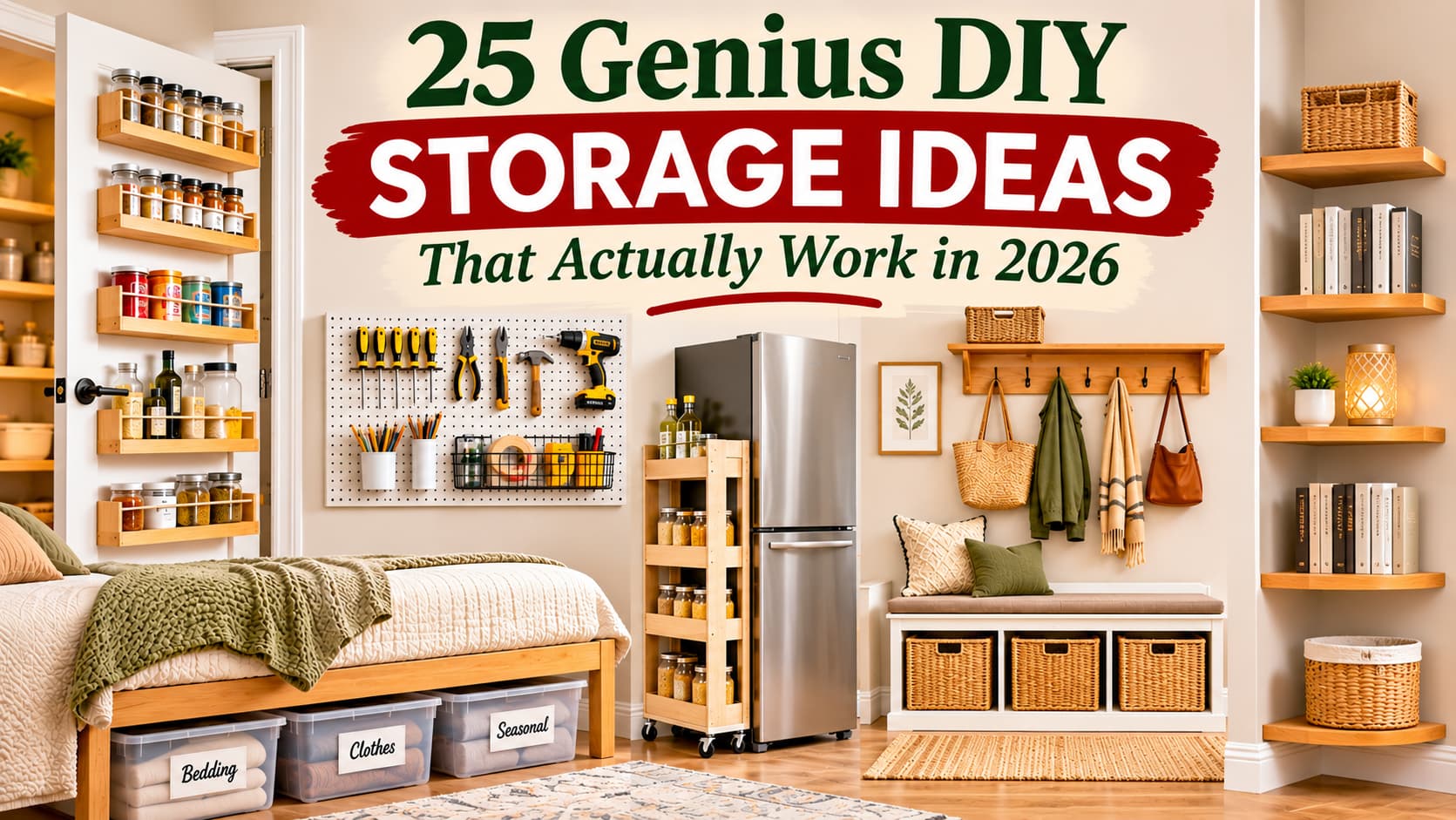
Most storage projects ideas fail for the same quiet reasons. The shelf is too deep, so things vanish at the back. The bin is too tall, so the bottom layer is never touched. The system takes five steps to use, so it collapses the first busy week. The ideas below were chosen to avoid those traps. Each one puts things where your hand already goes, keeps the effort of putting something away lower than the effort of dropping it on a chair, and can be built or assembled with ordinary tools in a few hours or less.
Before you start, a simple rule will save money. Store things at the place where you use them, at the height you can reach without a stretch or a stoop, and in a container you can see into or label at a glance. If an idea fits that rule in your home, it will probably work. If it does not, skip it, however nice it looks.
Idea 1: Shallow Shelves Behind a Door
A narrow shelf fixed to the back of a pantry, closet or utility door uses space nobody counts. Keep the depth to about four inches so every item is visible. This suits spices, tins, cleaning sprays, spare light bulbs and bathroom extras. Add a thin front rail from a wooden strip so nothing slides off when the door swings. Check that the door is solid enough to hold the weight, and that the shelf does not hit anything on the other side when closed.

Idea 2: A Pegboard Wall That Reorganizes Itself
Pegboard works because it lets you move things without new holes. Mount a sheet over spacers so the hooks have room behind it, then arrange tools, craft supplies or kitchen utensils where you reach for them. Trace each tool in marker once its spot is settled, and returning items becomes automatic. Fix the board to studs or use anchors rated for the load, and keep heavy tools low so the pulling force stays gentle.

Idea 3: Under Stair Drawers
The triangle beneath a staircase is wasted in many homes. Build a row of shallow drawers on full extension slides, each sized to the step above it. They suit shoes, seasonal items, board games or pet supplies. Measure each opening separately, because stair spaces are rarely square, and use plywood boxes with a plain front panel. A soft close slide makes the drawers pleasant enough that people use them.

Idea 4: A Rail and Hook Strip for the Entry
A single board with five or six sturdy hooks beats a closet for daily coats and bags, because there is no hanger to find. Mount it at a height that children can reach on the lower hooks. Put a small shelf above for hats and keys and a boot tray below. Screw into studs, since a loaded coat rail pulls hard on the wall.

Idea 5: Rolling Cart Gaps
The space of six to ten inches beside a fridge, washer or cabinet can hold a slim rolling cart. Build one from a narrow wooden frame with casters, or adapt a store bought cart. Use it for oils, canned food, laundry detergent or cleaning supplies. Measure the gap at the top and bottom, because walls lean, and add a handle so it pulls out easily.

Idea 6: Bed Frame Risers With Storage Bins
Raising a bed by four to six inches on sturdy risers opens room for flat bins. Pick risers rated far above the weight of the bed plus its occupants, and choose bins with lids that slide under without catching. Store off season clothes, spare bedding or shoes. Label the ends of each bin so you can identify them without pulling them out.
Idea 7: A Ceiling Rack for the Garage
Overhead racks hold bulky, rarely used items such as camping gear, suitcases and holiday decorations. Mount a frame to ceiling joists with lag screws, never to drywall alone, and respect the weight limit printed on any kit. Keep the load balanced and avoid placing anything heavy where it could fall onto a car or a person. Choose lidded bins so dust stays out.
Idea 8: A Magnetic Strip for Metal Tools
A strong magnetic bar keeps screwdrivers, pliers, scissors and knives visible and within reach. Mount it above a workbench or kitchen counter on studs or secure anchors. In a kitchen, a knife strip must be installed high enough and firmly enough that blades cannot be knocked loose, and kept away from the reach of small children.

Idea 9: Hanging Fabric Pockets
An over the door organizer with clear pockets is among the cheapest storage tools there is. It suits shoes, scarves, cleaning supplies, art materials and bathroom items. Choose pockets that are deep enough to hold what you plan to store, and check that the door still closes without scraping. Heavy loads can pull the hooks loose, so spread the weight.
Idea 10: A Floor to Ceiling Shelf in a Tight Corner
In a small room, vertical space is the only space left. Build a narrow bookcase from plywood or buy a tall slim unit and fix it to the wall with a safety strap. Keep the heaviest items low, and use adjustable shelves so you can change the layout as your needs change. A tall unit that is not anchored is a tipping hazard, especially in homes with children.
Idea 11: Crates as Modular Cubbies
Stacked wooden or sturdy plastic crates make flexible cubbies for toys, shoes, craft supplies or books. Fasten them together with screws or strong brackets so they behave as one unit, and sand the edges. The system is easy to expand or rearrange, and it can sit against a wall or form a room divider if the height is modest.
Idea 12: A Hidden Storage Bench
A bench with a lifting lid or drawers beneath gives you a seat and a home for things you rarely need. Use plywood with a lid supported by soft close hinges so it cannot drop on fingers. Place it in an entry, a bedroom or at the foot of a bed. Keep ventilation in mind if you store textiles, and avoid putting heavy items on the top shelf of an enclosed unit.
Idea 13: Wall Mounted Jar Rack for the Pantry or Workshop
Screw jar lids to the underside of a shelf and twist the jars into them, and small items become visible and tidy. This works well for screws, buttons, beads, spices and sewing notions. Use plastic or lightweight glass jars, and avoid filling them so full that the shelf is overloaded. Mount the shelf to studs when you store a lot of jars.
Idea 14: A Slim Pull Out Pantry
A narrow cabinet on full extension slides slips into a gap beside the stove or fridge and turns a dead space into a spice and sauce pantry. Build it from plywood, with a rail on each shelf so bottles cannot fall. It needs accurate measurements and sturdy slides rated for the full weight, but it is one of the most satisfying kitchen projects because everything is visible at once.
Idea 15: Closet Rod Doubling
A second hanging rod fitted below the first doubles space for shirts, skirts and folded trousers. Use an adjustable hanging bracket or a second rod fixed to the side walls at the right height. Do not overload the lower rod, and keep long coats and dresses on the main rod. For small closets, this is one of the lowest cost changes with the biggest effect.

Idea 16: Drawer Dividers Cut to Fit
A drawer without dividers turns into a heap in a week. Cut thin plywood or foam board into strips that fit your drawer, and assemble them into a grid. Make the sections slightly larger than the item they will hold so nothing jams. This works for cutlery, cables, makeup, craft tools and office supplies, and the cost is close to nothing.
Idea 17: A Bike Hoist or Wall Hook System
Bikes are awkward to store. A wall hook or pulley hoist lifts them out of the way and keeps the floor clear. Mount hooks into studs or masonry with proper anchors, and match the hook to the bike’s weight. Hang the bike by the frame or a wheel as the maker advises, and leave enough room so that handlebars do not scratch the wall.
Idea 18: A Laundry Sorter on Wheels
A wooden frame with three fabric bags or bins on casters sorts whites, darks and delicates before they reach the machine. Add a handle and a small shelf for detergent. It rolls to the washer, so no basket carrying is needed. Choose casters with locks if the floor is smooth, and size the bins to fit your normal load.

Idea 19: A Shoe Ladder or Slanted Rack
Shoes take up more room than people expect. A slanted rack holds pairs at an angle, so each takes a narrow strip of floor. Build it from a few boards, a frame and slats, or fit a ladder shelf against a wall. Keep the depth about the length of a shoe, and leave space beneath for boots. A mat tray catches dirt and keeps the rack clean.
Idea 20: A Curtain Covered Open Shelf
If you cannot afford cabinet doors, hang a simple curtain from a rod across an open shelf. It hides visual clutter in a bedroom, utility area or under a sink, and it costs far less than doors. Use a washable fabric and leave a gap at the bottom so air can move. In damp places such as under a sink, choose a fabric that dries quickly.
Idea 21: A Craft Wall With Rails and Cups
Horizontal rails with hanging cups, hooks and small baskets keep craft or hobby tools in view. A single rail can hold scissors, tape and paint brushes, and a ledge below it holds paper rolls. Place the rails at standing height for adults, or lower for children’s tables. Spacing the cups according to the tools they carry keeps the layout practical.

Idea 22: A Fold Down Wall Desk
A hinged desk that folds against the wall when not needed is perfect for small apartments. Use a solid board with heavy duty hinges and a stay or folding bracket to hold it level, and mount it to studs, because a loaded desk is a strong lever. Add a shelf above for supplies. When closed it reads as a flat wall panel.
Idea 23: Outdoor Storage in a Fence Corner
A small weatherproof box or a lean to shelter built against a fence can hold garden tools, hoses and cushions. Raise it off the ground on bricks or timber so it stays dry, slope the roof so water runs off, and choose treated or sealed wood. Secure the structure against wind, and check local rules if you build anything larger.

Idea 24: Paint Can and Hardware Shelf in the Utility Area
A sturdy shelf at waist height keeps paint, adhesives and fixings off the floor and easy to see. Use a lip along the edge, label the cans with the room and finish, and store them out of reach of children and away from heat. A small tray for brushes and a jar for spare screws make touch ups quick.
Idea 25: A Weekly Reset Bin
Sometimes the best system is a place for things that have no place. A clearly labeled bin or basket collects stray items during the week, and a ten minute sort each weekend returns them to their homes. It prevents clutter from spreading and costs nothing. Place one in each main living area if your household is busy.
How to Pick the Right Ideas for Your Home
Start by finding the three spots where clutter returns every week, since those are the places where storage will pay back fastest. Measure each space, note whether the wall is stud, masonry or drywall, and decide on a budget before you shop. Choose one project that solves the worst spot, finish it fully, and live with it for two weeks before starting another. A storage system that you have tested is more reliable than a plan.
Safety and Durability Checklist in Plain Words
Anything tall must be fixed to the wall. Anything heavy must be fixed to studs or masonry with fasteners rated for the load. Keep heavy objects low, sharp tools out of reach of children, and chemicals away from heat and food. If a project involves electrics or structural walls, hire a qualified professional.
Common Questions
What is the cheapest storage project to start with? Drawer dividers, an over the door organizer, and a weekly reset bin cost almost nothing and show results immediately.
How do I add storage in a rental? Use freestanding units, tension rods, over the door hooks and removable adhesive products rated for the weight, and avoid permanent changes unless your landlord agrees.
How do I make a small room feel bigger with storage? Go vertical, keep floors clear, use closed storage for visual calm, and choose furniture that stores things inside.
How do I keep a system from falling apart? Make putting things away easier than leaving them out, label everything, and review the system every few months.
Do I need power tools? Many of these ideas need only a drill, a saw and a level. Others can be done with ready made parts and a screwdriver.
Final Thoughts
Good storage is not about buying more containers. It is about giving every item a place that suits how you actually live. Pick the idea that solves your most annoying clutter spot, build it carefully, and let it prove itself before you move on. Over a few weekends, those small wins add up to a home that feels calmer and works better every day.
- 25 Genius DIY Storage Ideas That Actually Work in 2026
- How to Make Stunning Rustic Birch Log Reindeer for Your Porch and Garden
- Black Friday Email Design in Flodesk: 5 Stunning Steps to an Email That Looks Like Your Brand
- DIY Christmas Gnome Decor: 25 Easy & Cute Gnome Crafts, Ideas and Step-by-Step Tutorials for Budget-Friendly Holiday Decorating
- 53 Easy & Cute Christmas Craft Ideas for Kids: Simple DIY Holiday Crafts, Ornaments & Decorations for Toddlers and Preschoolers

Leave a Reply